Wednesday, May 1, 2019

How to Protect Our National Parks During a Shutdown? Keep Them Closed

Image result for national park closed
An Entrance of Yellowstone National Park during the 2013 Government Shutdown
Source: NPCA Photos, Flickr.com
A child peering through a locked fence at Lincoln Memorial.  A line of cars being turned away from campgrounds in a National Park.  These were the sort of images that spread across the media during the 2013 Federal Government shutdown.  The photos of unfulfilled family vacations and interrupted field trips fueled a large backlash against the Obama Administration, who had shut the parks and monuments down due to a lack of congressional funding.  When the Federal Government again shut down this year, the Trump Administration remembered the vitriolic tone of the images shared in 2013 and how they had been weaponized against their predecessors.  They looked to avoid such a backlash and appease the public, so this time they kept the gates open to some of our most precious national resources.

The gambit did not work.  A different backlash soon spread across the media.  Instead of faces of sad children, pictures of trash heaps were shared along with dirty bathrooms and mobs of cars.  The masses were allowed into the parks but there was little to no staff to control them.  The administration could not avoid the criticism and their decision caused damage to be wrought at numerous National Parks.  But public attention and the media cycle are both short, and the government shutdown now seems in the past.  Yet the effects of this tumultuous time will be felt in the National Parks and other protected lands for years to come.  The litter has been removed and the bathrooms are now clean, but it will take some time before the parks fully recover.

Wednesday, February 21, 2018

Beyond Taxes: Alternative Funding for Conservation Through Ecotourism

"(The National Park Service's) purpose is to conserve the scenery and the natural and historic objects and the wildlife therein and to provide for the enjoyment of the same in such a manner and by such means as will leave them unimpaired for the enjoyment of future generations" -- NPS Organic Act of 1916
"Why do I have to pay an entrance fee?  I pay taxes don't I?" -- Average Citizen at a Park Entrance, Every Country 

Entrance Fees Often Cause Bottlenecks into Nature Reserves, But Why Are They Necessary?
Source: The Chicago Tribune

Trouble at the Gates


 We often take nature for granted.  The expansive wilderness always seems like it is just outside our window.  We, as individuals, do not spend much time out there but we take solace in the fact that we could head out into the great outdoors whenever we please.  It can come as quite a surprise when, upon trying to do so, we find ourselves stopped at a kiosk with a friendly Park Ranger demanding ten dollars for the right to go romping through the forest.

People often respond indignantly to such a price.  How can it cost anything to visit a park?  Is it not the purpose of taxes to provide funding for government programs such as this?

The truth is that environmental conservation, preservation, and protection are globally underfunded.  For example, in 1994 it was estimated that all of the world's existing protected areas needed to be allocated $17 billion in order to be maintained in their present state.  Only $4.1 billion ended up being budgeted worldwide, compared to $245 billion that was budgeted for agricultural subsidies in the same year.  Right now, the US National Parks have a maintenance backlog with a projected cost of $11.3 billion.  This is why parks are understaffed and fees are required for entry.
Image result for National Park funding
A Graph of Funding for the National Forest Service's Recreation, Heritage, and Wilderness Programs Since 2001
Source: The National Wildlife Federation


This gets at an innate paradox within the conservation movement.  Conservation looks to sustain natural diversity to its highest potential, yet must also be financially sustainable and socially accessible to do so.  This is a hard balance to uphold; actions that are best for the health of the ecosystem often go against economic trends or the demands of the visiting public.  Additionally, environmental projects are expensive yet the bulk of governments' budgets are allocated to more popular issues like defense or infrastructure.  But conservationists do not have to solely rely on public funding.

It has been proposed that conservationists should partner with the tourism industry in order to make protected areas more accessible and more profitable.  Ecotourism and wildlife experiences have become highly popular as a growing urban population looks to find repose in beautiful sceneries and biodiverse areas.  Tourism is a $1.5 trillion industry globally, with environmentally themed programs making up 20-40% of these profits.  If conservation organizations could tap into these revenues, then their funding problems could be a thing of the past.

Friday, January 26, 2018

Trash-Picking and Traffic-Waving: The Truth About Being a Park Ranger

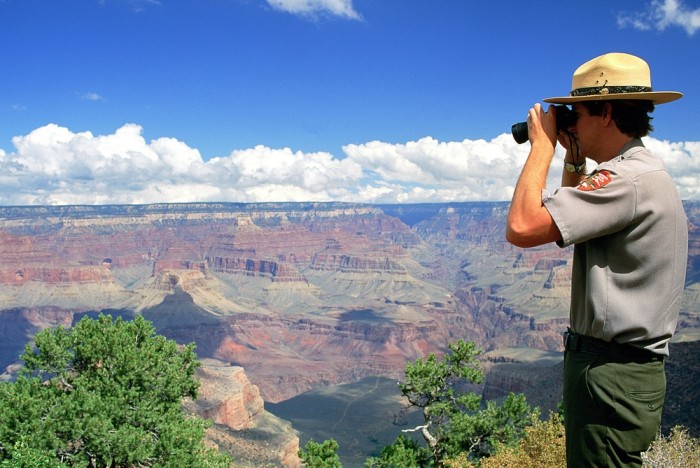
For most, the outdoors is a place for relaxation and recreation.  People head into its great expanse to take a leisurely walk, kayak a difficult river, climb a beautiful vista, or to hunt some elusive game.  Whatever one does when one is in nature, the goal is to take a break from a stressful and fast-paced life and to recuperate one's self.  Yet for some, nature is also a workplace.  These individuals have decided to turn their love for wilderness into a career and thus dedicated their time to the preservation of our natural spaces.  You can see these people whenever you visit a park, standing in their green or khaki uniforms.  But what is it actually like to work in the great outdoors?
Image result for Park Ranger
Its a lot less of this than you think
Source: The Today Show

I work as a park ranger for the Maryland Park Service and some of the most common questions I get from visitors are variants of  "Is your job the best job ever?"  The question is then usually followed by, "I would love to be a park ranger, I love going to parks so I'm sure I would be a natural."  Well, zeal for nature is a key ingredient for any aspiring ranger but the job is a little more complex than that.  That's why I would like to take a few moments to explain what it is really like to work as a park ranger.

The first thing that anyone looking into this career should know is that park ranger positions are quite competitive.  Americans are much more environmentally conscious than they were in the past and many also desire atypical work environments, having been burnt out in the standard 9-5 office setting.  Thus park services in both the state and federal level always have a healthy batch of applicants for every job that they advertise.  Ground-level positions with the National Park Service are notorious for being extremely competitive and an applicant will need much more experience than the requirements specify to stand out amongst the crowd.  I recommend starting at the state level and gaining experience there before seriously attempting to get a job with the National Park Service.  Many parks or reserves will not even consider applicants who do not either have a relevant degree or a few years of environmental experience under their belts.  Rangers are, above-all, the stewards of the natural sites on which they work and it is important that they have a good understanding of the science that governs such places.

Friday, December 29, 2017

Rethinking America's Best Idea

The battle we have fought, and are still fighting, for the forests is a part of the eternal conflict between right and wrong, and we cannot expect to see the end of it...The fight for the Yosemite Park and other forest parks and reserves is by no means over; nor would the fighting cease, however much the boundaries were contracted.  Every good thing, great and small, needs defense.  The smallest forest reserve, and the first I ever heard of, was in the Garden of Eden; and though its boundaries were drawn by the Lord, and embraced only one tree, yet even so moderate a reserve as this was attacked.  
-John Muir
Image result for American forest
An Example of North American Forest and Mountain Range
Source: Americanforests.org

When the United States set aside land for the world's first national parks, the country changed how people interacted with nature forever.  During the era of American expansion, when land was being purchased, settled, and developed at unprecedented rates, environmentally conscious citizens sought to protect places that they deemed to have natural and inherent beauty.  Thanks to the efforts of men and women like John Muir and Theodore Roosevelt, these places were cordoned off from the bulldozer that was industry.  Surveys were completed, boundaries were drawn, and political fences were erected in the hope that such wildlands would remain free and pure.  The effort was deemed a huge success; the national parks became a part of the American identity and documentarian Ken Burns declared them "America's best idea."  Yet the matter is not settled.  Official words on paper and good intentions are not enough to keep our landscapes safe.

Forces, both natural and man-made, continue to conspire to endanger the scenery that our predecessors set aside.  Agencies and groups labor desperately to preserve environments in the same conditions as our ancestors found them.  With encroaching forces like climate change and pollution assaulting them constantly, such endeavors can seem to be an uphill battle.  To be blunt, our efforts to preserve in an era of change are impossible tasks.

Preservation, in the vein of its nineteenth-century creators, is an indefensible goal.  Its central ideas of a self-maintaining wilderness and ideal static sceneries are flawed and need to be done away with.  Wilderness, as defined by the Wilderness Act of 1964 as "an area where the earth and its community of life are untrammeled by man, where man himself is a visitor," does not exist.  Man's reach now extends beyond his gaze.  Though a region may appear remote, wild, and unspoiled, it is always threatened by the same impinging forces that jeopardize every other part of the planet.  To be successful in our mission to protect natural scenery, we must do away with antiquated notions about change and set new priorities for our lands.

Sunday, December 10, 2017

Conservation Versus Preservation: A Formative Debate

Theodore Roosevelt and John Muir at Yosemite, two champions of conservation and preservation respectively
Source: Shout! Magazine

In the mid-nineteenth century, the American environmental movement began and, for the first time, citizens began to think of nature as a resource to be protected.  The first national parks were created and political leaders such as Theodore Roosevelt lauded America's natural spaces as its greatest assets.  People flocked to these places like never before and countless areas were saved from overconsumption and development.  This period is thought of as a triumph for the environment, but there was a fair amount of discord as well.  There was an internal debate within the movement between its most prolific leaders.  The argument was whether these natural spaces should be conserved or preserved for the future.

To many, this may seem an odd debate because, in common speech, conservation and preservation are used interchangeably.  Back in the formative years of environmentalism, the two words represented different ideas about how best to manage nature.  Conservationists sought to stem the overexploitation of natural resources through wise harvest.  They believed long-term use of resources is more economically rewarding than immediate profits and destruction of the resource.  Conservationists were primarily motivated by economics and were focused on valuable or game species, or upon advantageous results such as slowing soil erosion and protection of water supplies.  Preservationists, on the other hand, endeavored to protect nature from any economic use or development whatsoever.  This group was only concerned with the preservation of an area "as is" and did not single out any specific species or resource.  Natural ecosystems were seen as self-maintaining and were only to be protected from human influence.

The two groups had the same overall goal.  They wanted to protect the majestic wilderness and natural resources that America contained.  What differed was how best to accomplish this goal.  In some ways, the debate continues to this day.  Perhaps that is to our own detriment, as the old views about nature may not hold relevance in today's environment.  For now, let us just explore how this early debate shaped the future of how this country interacts with its ecosystem.